
Product Description
Products Collection
Product Description
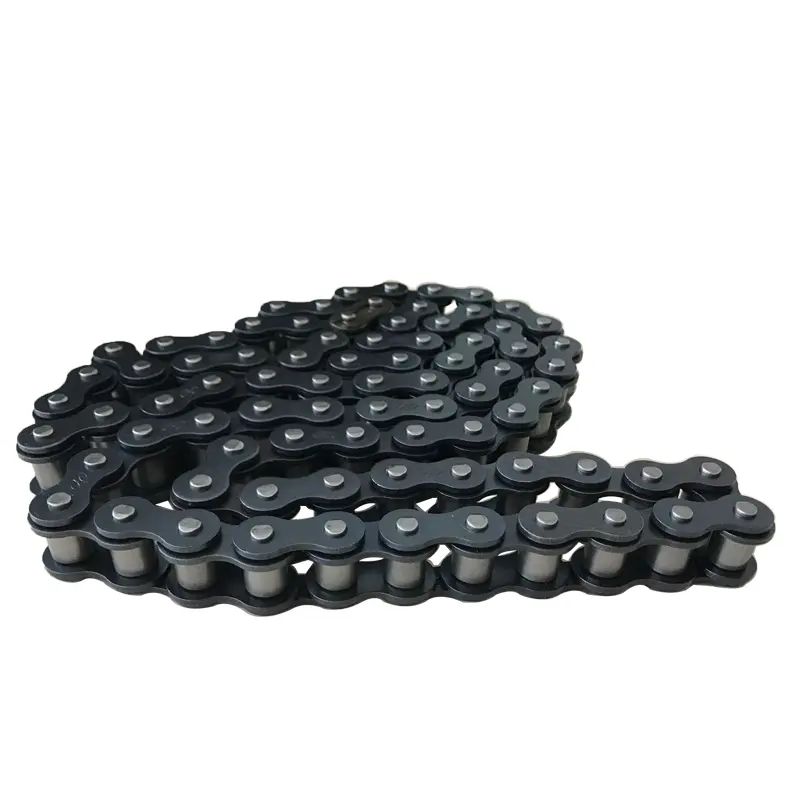
Our QLD series silent chain is a power transmission chain designed for high-speed and high-torque applications. It is known for its quiet operation, long life, and high efficiency.
The chain features a high-strength construction that allows it to handle heavy loads and high speeds without stretching or breaking.
When you need a specific design, we can provide customised solutions based on what you need. Whether you require specific features, plans, materials, or specifications, our team can work to ensure you get a chain that fully meets your needs.
Are you looking for other chains?
Leave your message below, and feel free to contact us!
FAQ
| Question 1: Are you a Manufacturer or a Trading Company? |
| Answer: We are a 100% chain manufacturer with 23 years of experience |
| Question 2: What should I provide to get a quotation? |
| Answer: 1. Type of the chain (with photos if available) 2. Pitch of the chain 3. Width of the chain 4. Length and quantity of the chain 5. Other specific requirements |
| Question 3: How long is your manufacturing and delivery time? |
| Answer: Products are usually finished in 2 weeks, depending on the type and quantity. Also, please get in touch with us to check the delivery time to your destination. |
| Question 4: How long is your guaranteed time? |
| Answer: We offer a three-year guarantee if you purchase chains and matched sprockets together. If you need chains only, a one-year guarantee can also be confirmed. |
| Question 5: Trade terms and Payment terms? |
| Answer: We accept EXW, FOB, DDU, Door to Door. Payment terms, such as T/T, L/C, and Western Union, are acceptable. We also provide the service of Online Trading in this B2B platform. |
Company Profile
| Standard or Nonstandard: | Standard |
|---|---|
| Application: | Textile Machinery, Garment Machinery, Conveyer Equipment, Packaging Machinery, Food Machinery, Marine, Mining Equipment, Agricultural Machinery |
| Structure: | Tooth Chain |
| Samples: |
US$ 100/Meter
1 Meter(Min.Order) | Order Sample |
|---|
| Customization: |
Available
| Customized Request |
|---|
.shipping-cost-tm .tm-status-off{background: none;padding:0;color: #1470cc}
|
Shipping Cost:
Estimated freight per unit. |
about shipping cost and estimated delivery time. |
|---|
| Payment Method: |
|
|---|---|
|
Initial Payment Full Payment |
| Currency: | US$ |
|---|
| Return&refunds: | You can apply for a refund up to 30 days after receipt of the products. |
|---|
How does the design of a transmission chain impact its efficiency?
The design of a transmission chain plays a crucial role in determining its efficiency and overall performance. Here’s a detailed explanation:
1. Link Shape and Geometry: The shape and geometry of the chain links directly affect the efficiency of power transmission. Chains with optimized link designs, such as streamlined or curved profiles, reduce friction and minimize energy losses during operation. These design features enhance the chain’s efficiency and contribute to smoother power transfer.
2. Bearing Surfaces: The design and quality of bearing surfaces in a transmission chain significantly impact its efficiency. Well-designed chains incorporate precision-machined bearing surfaces that minimize friction and wear. Smooth and accurately machined surfaces reduce energy losses caused by friction, resulting in higher efficiency and improved overall performance.
3. Roller and Bushing Design: The design of the rollers and bushings in a transmission chain can greatly influence its efficiency. Chains with properly designed rollers and bushings reduce friction and enable smooth rotation. Low-friction contact surfaces between the rollers and sprockets ensure efficient power transmission, reducing energy waste and improving the overall efficiency of the chain.
4. Lubrication System: The design of the lubrication system within the chain also affects its efficiency. Proper lubrication reduces friction and wear, allowing the chain to operate more efficiently. Some transmission chains incorporate self-lubricating features or advanced lubrication mechanisms to ensure optimal lubrication throughout the chain, further improving efficiency.
5. Material Selection: The choice of materials for the chain’s components, such as links, rollers, and bushings, impacts its efficiency. High-quality materials with excellent wear resistance and low friction coefficients contribute to higher efficiency. Additionally, lightweight materials can reduce the overall weight of the chain, resulting in lower inertia and improved efficiency.
6. Precision Manufacturing: The precision and accuracy with which a transmission chain is manufactured can directly affect its efficiency. Chains produced with tight tolerances and high-quality manufacturing processes ensure proper fit, reduced friction, and optimal power transfer, resulting in improved efficiency.
It is important to note that the design considerations and features mentioned above can vary depending on the specific type and application of the transmission chain. Consulting with experts or manufacturers can provide further insights into the design features that optimize efficiency for a particular transmission chain.
Can transmission chains be used in power transmission systems?
Yes, transmission chains can be used in power transmission systems. Here’s a detailed answer to the question:
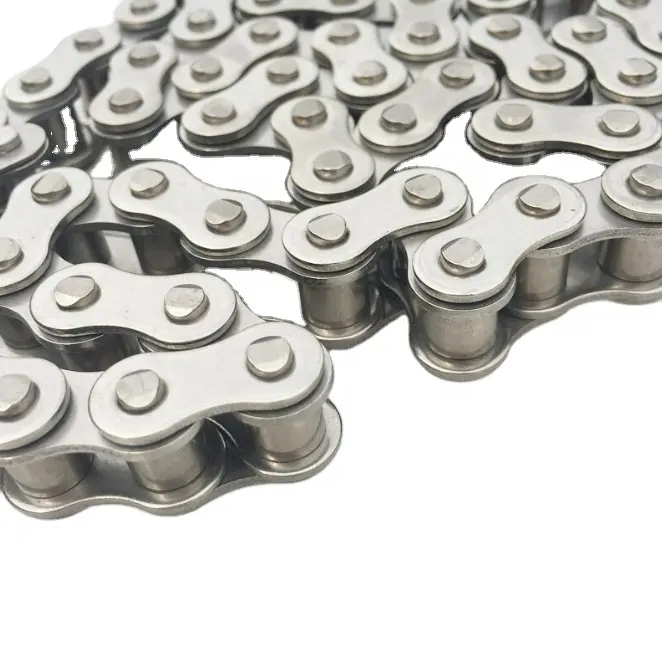
Transmission chains are commonly employed in various power transmission applications where the transfer of mechanical power is required. These chains are designed to transmit rotational motion and power from one shaft to another.
Transmission chains are used in a wide range of power transmission systems, including:
- Industrial Machinery: Transmission chains are used in machinery such as conveyor systems, packaging equipment, printing presses, and machine tools to transfer power and motion between different components.
- Agricultural Equipment: Transmission chains are utilized in farm machinery like tractors, combines, and harvesters to transmit power from the engine to various mechanical components for tasks like cutting, threshing, and planting.
- Automotive: Transmission chains can be found in certain automotive applications, such as motorcycle drive chains or timing chains that synchronize the rotation of the crankshaft and camshaft in internal combustion engines.
- Power Generation: Transmission chains are employed in power generation systems, including wind turbines, hydroelectric turbines, and steam turbines, to transmit rotational motion from the turbine to the generator.
- Construction Equipment: Transmission chains are used in construction equipment like excavators, loaders, and bulldozers to transfer power and motion from the engine to the drivetrain and various hydraulic components.
Transmission chains offer several advantages in power transmission systems:
- High Efficiency: Transmission chains have minimal power losses, allowing for efficient power transfer.
- High Load Capacity: Transmission chains are capable of handling high loads and transmitting substantial amounts of power.
- Flexibility: Transmission chains can be easily customized to fit different applications, with various sizes, lengths, and configurations available.
- Durability: Transmission chains are designed to withstand heavy-duty applications and offer long service life when properly maintained.
- Cost-Effective: Transmission chains are often a cost-effective solution compared to other power transmission options.
It’s important to select the appropriate type and size of transmission chain based on the specific requirements of the power transmission system. Regular maintenance and lubrication are also essential to ensure optimal performance and longevity of the transmission chain.
Can transmission chains be used in high-speed applications?
Yes, transmission chains can be used in high-speed applications, but there are certain considerations to take into account. Here’s a detailed explanation:
1. Chain Design: High-speed applications require transmission chains that are specifically designed to withstand the increased rotational speeds and dynamic loads. These chains often have features such as specialized surface treatments, high-quality materials, and precision manufacturing to ensure smooth operation at high speeds.
2. Lubrication: Proper lubrication is crucial in high-speed applications to minimize friction, heat generation, and wear. Lubricants with excellent high-speed characteristics, such as low viscosity and high film strength, are typically recommended. In some cases, specialized lubrication systems, such as oil circulation or spray lubrication, may be used to ensure sufficient lubrication at high speeds.
3. Balancing: High-speed operation can induce vibration and imbalance in transmission chains, leading to increased stress and potential failure. Balancing the chain and associated components, such as sprockets and shafts, is important to minimize vibration and ensure smooth operation at high speeds.
4. Tensioning: Proper tensioning of the transmission chain is crucial in high-speed applications. Maintaining the appropriate tension helps prevent chain slippage, excessive vibration, and premature wear. Tensioning devices, such as automatic tensioners or spring-loaded systems, may be used to ensure optimal tension throughout the operation.
5. Maintenance: Regular inspection, lubrication, and maintenance are vital in high-speed applications to detect any potential issues and address them promptly. Periodic checks for wear, proper alignment, and lubrication effectiveness can help prevent unexpected failures and ensure the reliable performance of transmission chains.
It is important to consult with manufacturers or industry experts to select the appropriate transmission chain that is specifically designed and rated for high-speed applications. By following the recommended guidelines and maintenance practices, transmission chains can reliably and safely operate in high-speed environments, meeting the performance requirements of such applications.


editor by CX 2023-11-27